
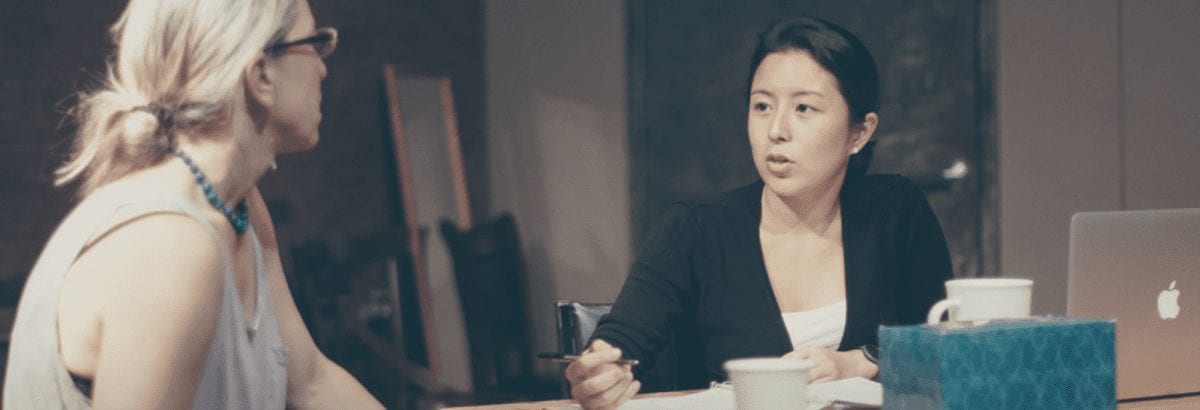
TBG’s playwriting program encourages simplicity and clarity in story-telling. We share practical tools that can easily be applied to your writing, ignite the imagination, and demystify the revision process. Our approach highlights the structural pillars of a well-told narrative and helps writers establish clear contexts, so that their stories will have greater impact. TBG’s writing tools leave room for a wide range of expression, supporting all genres—from simple, intimate, powerful, character-driven plays to epic tales with stylized language. Whether you are a playwright crafting ten-minute plays or wanting to start and/or finish a full-length script, you’ll find yourself in a supportive workshop environment of committed theatre artists.
“Had Arlene Hutton been around during Broadway’s golden age, her finely wrought plays might rank with those of William Inge or Horton Foote. Among postmodern dramatists, Hutton stands apart, relying on traditional techniques in an era where such values grow ever rarer.” –David Nichols, LA Times
"Arlene Hutton is so supportive of her students, so genuine in her enthusiasm, so encouraging of exploration. I was talking to some of the other students as we left, and there was a consensus of buoyed enthusiasm and excitement from everyone in the room. People left her workshop truly excited to write. I think that she gave a lot of students back their confidence and inspired newfound passion for the craft in others." –Becca Worthington, playwright
Quarterly Classes
Playwriting Intensive: Process
There is nothing like a deadline to get you writing and keep you going! Modeling on The Barrow Group aesthetic of using “tools,” this workshop includes in-class writing and out-of-class homework. As a supportive collective we’ll read and discuss our pages in class. Whether you are looking at finishing a first draft of a play or improving your writing process with scenes and one-acts, this workshop will provide you with positive support through examining techniques and tools. Are you a writer who starts from character or from story? We’ll look at themes, structure and character in an environment that brings out and channels your creativity. No prerequisites are required for this class.
Advanced Playwriting Intensive
Prerequisite: Students must have taken Playwriting Intensive I or submit a 10-page writing sample to school@barrowgroup.org for consideration.
This on-going workshop provides a laboratory for serious playwrights who are experienced writers. Combining the use of “tools” and a formal response process, participants will bring in pages each week to be read and discussed. There is nothing like a deadline for a writer and by the end of just a few months you should have a draft of a new full-length play or a serious revision of a work-in-progress. Utilizing Barrow Group actors we will, as needed, show our work in public readings.
Playwriting Master Class - by invitation only
Prerequisite: By invitation only. Students must complete Advanced Playwriting to be considered.
This on-going workshop provides a writers’ group for serious playwrights who have taken the Intensive and Advanced levels of writing classes at The Barrow Group. Participants may begin a new work or continue to move forward on long term projects, and are committed to sharing their pages each week with the group to read aloud and discuss. The Master Class will culminate with actors reading longer sections from the works-in-progress and hopefully the playwrights will begin submitting their work to theatre and contests.
1 and 2-Day Workshops
Weekend Workshop: Playwriting Jumpstart
For playwrights, actors, directors, designers and anyone interested in exploring the creative process and broadening their skills in storytelling, this 1-day workshop is for you! Whether you are new to playwriting or in the middle of a project, you already possess, deep inside you, everything you need to jumpstart your art and bring forth your unique voice. For theatre artists and writers of all genres looking for ideas, this workshop includes a series of in-class exercises which reveal a roadmap to the wonders and revelations of the unconscious mind.
Weekend Workshop: Playwriting Revisions
You’ve got a draft of a scene or short play – what’s next? Maybe you’ve heard your words spoken aloud and maybe you haven’t, but writing is rewriting and this workshop will give you a set of tools for your current and future work. Through exercises, examples and a series of questions, you will look at your plays with new eyes and fresh ideas. Bring something old or something new: --A ten-minute or short play that you want to revise --A scene from a longer work that is ready for the next step --The first 10-15 pages of a full-length --Or just bring yourself and a pencil! (We’ll have a short play by another author for you to revise!) In addition to reading work aloud for discussion, we’ll also cover questions about formatting, submissions, new play development, collaboration, staged readings and anything that helps you take your drafts to the next stage. You'll leave this 1-day workshop with a new set of skills and handouts to help focus your revisions.
Playwriting Weekend Workshop: Jumpstart & Revisions
This 2-day weekend workshop combines Jumpstart and Revisions into one weekend.
"Scott Organ's Advanced Playwriting classes are exceptional. Each student's work is given constructive, thoughtful, respectful feedback. A very democratic approach.. encourages hard work , wonderful camaraderie , and a unified desire for each classmate to become the writer they hope to be." –Jeannette Reid, Washington, student
Playwriting Intensive: Structure
The word playwright (like boatwright or cartwright) means “maker” of plays, not writer of plays.
Playwrights are craftspeople and as reliant on structure as a carpenter or mason. In this class, we begin with an idea that resonates and build from there. Taking cues dating back to Aristotle, we will explore basic structure as we put pencil to paper. Once the framing is in place, we are free to explore and seek out those qualities that are valued in acting – something real, spontaneous, new. We will endeavor to surprise ourselves as we work. With a combination of home and class writing, we’ll share work in class – a safe environment for exploration where inner rebels won’t be provoked, all in the service of telling a sound, entertaining and surprising story.
In Level 1, I honor the notion of starting with an idea, craft the structure first, and then strike out and begin writing.
Advanced Playwriting Intensive w/ Scott Organ
Prerequisite: Students must have completed Playwriting Intensive I.
In the Advanced Playwriting Intensive, playwrights will continue to use and build on the structural tools learned in Playwriting Intensive: Structure. In this class, students will hit the ground running, bringing in material to share starting with the first class. As we explore and hone our storytelling, we will dig deeper into the nuances of compelling storytelling. Finally, this class offers a deadline. As the Irish proverb reminds us: "you cannot plow a field by turning it over in your mind."
Playwriting Master Class w/ Scott Organ
Prerequisite: By invitation only. Students must have completed Advanced Playwriting for consideration.
Finding Your True Subject: How to Write the Play That Only You Can Write
As audiences, we have all sat though plays wondering why the playwright has chosen this particular subject to write about. As playwrights, we have all struggled to approach a subject that we want to write about but can’t find our way into. Finding Your True Subject provides the tools to unlock these subjects, striving to help each writer discover what you (and only you) can bring to a subject, whether that subject is autobiographical or not. This class will assist students in identifying their true subjects and celebrating what they can uniquely bring to a play.
Writing for TV I
Writing for television is just like every other kind of dramatic writing…until it isn’t. For those intrigued by writing for the small screen, Writing for TV I is an introduction to what is universal and what is unique about television writing. The class will start by helping students create and flesh out the basics of a compelling story – a great protagonist, a great antagonist, and conflict that takes place in a powerful and exciting world. Then students will learn how to use particulars of television writing – creating a story engine, juggling multiple plots, and writing beat sheets – to further illuminate the characters and stories they have created. Students will work towards the creation of a pilot that will tell one great story while hinting at many more. Part I of a two part course.
**Please note, there may be additional costs associated with renting or streaming some TV shows to watch as part of the curriculum.
Writing for TV II
Prerequisite: Students must have completed Writing for TV I.
You’ve got your story. You’ve got your characters. You’ve got the world of your show. Now all you have to is WRITE IT. Writing for TV II will guide you through the process of writing a TV pilot. It will help you navigate the dauntingly specific challenges of the form (the classic guideline requires each pilot to hit 15 specific story beats) while never losing sight of what is thrilling and unique about it. Writing for TV II will be a combination of skills class and writing workshop, learning to use the demands TV writing not to frustrate your creativity, but to help it flourish.
Writing for TV Weekend Workshop
The Writing for TV Weekend Workshop provides a quick introduction to the process.
"The "Screenwriting I" course offered at The Barrow Group served as a fantastic platform to jump-start my writing career. As someone who had no formal education or experience in the field, the class provided a very basic and intuitive structure to the art of screenwriting. Once the fundamentals had been establish, the professor, Lorrel Manning, reinforced these concepts by having the class read various screenplays from well-known films. We also immediately put these new skills to use by writing our own scenes. As the weeks passed, the writing went from single scenes to multiple scenes to our very own short films. Lorrel provided direct and invigorating feedback along the way to ensure we kept our dialogue and scene construction focused. Although the class has ended, the ongoing assistance from colleagues and Lorrel has been indispensable as I journey through my new career. By the end of the eight week program, I not only learned how to write a screenplay, I wrote one myself. I also made invaluable contacts in the industry with the same interests and aspirations as myself that I intend on valuing for the years ahead." –Sean Jussen
Screenwriting I
The final project will be an original, self-contained short screenplay (10-15 pages) which students will outline, write and revise during the last 3 weeks of the class.
Screenwriting II
Prerequisite: Students must have completed Screenwriting I or submit a 10-page writing sample. Submit it here!
Students will then be guided in creating a strong logline/pitch, a detailed outline and/or treatment, then writing the first act (first 25-30 pages) of their screenplay. Students will receive expert guidance every step of the way from the instructor and their peers, by following a very structured and protective feedback paradigm.
Screenwriting III
Prerequisite: Students must have completed Screenwriting II.
This class is a continuation of II in which students continue to write and revise their feature-length scripts or pitch and write a new feature-length or short screenplay. Pages will be read aloud weekly in class. For feedback, the class will follow a very structured and protective feedback paradigm.